There is a peculiar failure that afflicts intelligent men more often than stupid ones.
They understand what is happening.
They can name the incentives in the room. They recognize manipulation while it is occurring. They see why the less competent man keeps advancing, why the superior keeps withholding recognition, why the rival is positioning himself, why the negotiation is slowly moving against them.
Ask them afterward what happened and they can give you an excellent explanation.
And then they lose anyway.
This is not because intelligence is useless.
It is because intelligence carries a hidden danger: understanding something can produce the sensation that you have done something about it.
You have not.
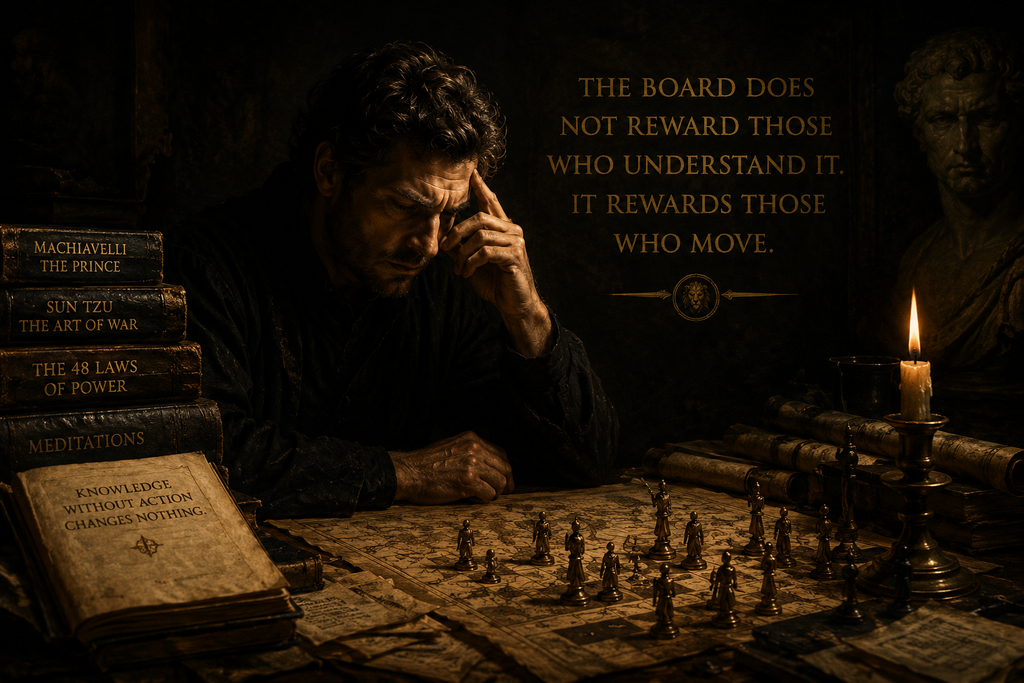
The board does not award points for comprehension.
It records moves.
Knowledge has a narcotic effect
There is pleasure in understanding.
A confusing situation becomes legible and the mind experiences relief. What appeared chaotic suddenly has structure. You discover the concept of leverage and recognize why someone keeps getting his way. You study status and finally understand why another man’s mediocre ideas receive more attention than your better ones.
The revelation feels like progress.
Sometimes it is.
But there is a dangerous point beyond which another insight produces almost no additional advantage.
You already know enough to move.
What you lack is not another principle.
You lack the willingness to place something on the board.
This distinction matters because learning is extraordinarily safe.
A book cannot reject you.
An essay cannot retaliate.
A strategy written in your notebook cannot embarrass you.
You can spend three years studying negotiation without ever making a demand that might be refused. You can understand office politics perfectly while refusing to cultivate the person whose support you need. You can study influence while continuing to speak exactly as you always have.
Knowledge permits you to approach the battlefield without entering it.
And because you are standing close enough to hear the fighting, you can convince yourself that you are participating.
The intelligent man has better excuses
Ignorance is relatively easy to diagnose.
A man does not know what to do, so he searches for an answer.
The more dangerous condition is knowing approximately what must be done and continuing to search anyway.
Here intelligence becomes an accomplice.
The mind produces sophisticated reasons for delay.
I need to understand his motives better.
The timing is not quite right.
I need more leverage first.
There may be consequences I haven’t considered.
All of these statements may be true.
That is precisely why they are so useful as excuses.
A foolish excuse is easily rejected. An intelligent excuse can keep a capable man motionless for years.
There will always be another variable to examine.
There will always be another book.
There will always be another interpretation of the other man’s intentions.
Eventually analysis stops reducing uncertainty and begins protecting you from it.
You are no longer gathering intelligence for the move.
You are gathering intelligence instead of the move.
Strategy begins where certainty ends
No serious strategist possesses complete information.
He cannot.
The moment another human being is involved, uncertainty enters the board.
You do not know exactly how the rival will respond.
You do not know whether the superior will reward the initiative.
You do not know whether the person you approach will become an ally.
You do not know whether the negotiation will bend when pressure is applied.
The amateur therefore waits for certainty.
The strategist asks a different question:
What is the smallest move I can make that will give me better information?
This changes everything.
Instead of spending another month wondering whether a colleague is actually hostile, you give him a small opportunity to support you and observe what he does.
Instead of theorizing about whether your work is invisible, you deliberately place one important result where the decision-maker cannot miss it and watch what follows.
Instead of wondering how much leverage you possess in a negotiation, you make a controlled demand.
The move produces information that contemplation could never produce.
Now the board speaks back.
That response becomes intelligence.
Then you move again.
This is how actual strategy develops: not as a magnificent plan constructed before contact with reality, but as a sequence of intelligent actions followed by observation and adjustment.
Move. Read. Adjust. Move again.
The man who demands certainty before the first move never enters this cycle.
A maxim is not a strategy
This is where most students of power eventually become collectors.
They accumulate principles.
Never outshine the master.
Conceal your intentions.
Know the terrain.
Control the frame.
Cultivate leverage.
Protect your reputation.
All useful.
None is a strategy.
A maxim is compressed knowledge. It tells you something generally true about human affairs.
A strategy answers a far more uncomfortable question:
What do you do Tuesday morning about the particular man standing between you and what you want?
Now abstraction disappears.
Who actually controls the outcome?
What does he want?
Who influences him?
What does your rival possess that you do not?
Where are you exposed?
What assumption have you made that has never been tested?
What can you do this week that changes one of those conditions?
Those questions are harder because they cannot be answered elegantly.
They require names.
They require consequences.
They require you to stop discussing power as a subject and locate yourself inside an actual distribution of it.
That is the point at which many intelligent men retreat back into theory.
Theory was cleaner.
The world cannot see what you understand
Imagine two men.
The first has read fifty books on strategy. He understands Machiavelli, Sun Tzu, psychology, negotiation and status. His analysis of every situation is excellent.
The second knows half as much.
But once each week he takes one intelligent action based on what he knows.
He initiates the conversation.
He makes the introduction.
He documents the victory.
He withholds the unnecessary concession.
He tests the alliance.
He asks for the position.
He forces the ambiguous relationship to reveal itself.
After one year, the first man possesses a magnificent mental model.
The second possesses a different life.
This is because the external world has no access to your understanding.
It cannot reward the strategy in your head.
Other people can respond only to what enters reality: the conversation you initiated, the boundary you enforced, the alliance you formed, the work you made visible, the demand you finally made.
Private understanding produces no external consequence until it becomes public action.
This sounds obvious.
Watch how few intelligent people live as though it were true.
Every unresolved situation is charging you rent
There is another reason men delay.
They treat inaction as neutral.
It is not.
If a rival is accumulating influence while you analyze him, the board is moving.
If someone else is receiving credit for work you continue quietly producing, the board is moving.
If a superior has formed a weak perception of you and you provide no contradictory evidence, the board is moving.
If a relationship repeatedly crosses your boundaries and nothing changes, the board is moving.
Time does not preserve positions.
It compounds them.
Every repeated interaction teaches the people around you what they can expect from you. Every concession makes the next concession easier to demand. Every month of invisibility makes your invisibility appear more natural. Every unanswered maneuver becomes evidence that the maneuver works.
This means the cost of waiting is not merely the opportunity you failed to take.
You are allowing the existing arrangement to harden.
The longer a hierarchy exists, the more it begins to look legitimate.
Eventually you stop saying this situation has continued for two years.
You begin saying:
This is simply how things are.
That sentence has buried more ambition than failure ever did.
Stop studying the war you are already in
There is a time for reading.
There is a time for observation.
There is a time for patient preparation.
But preparation has a purpose.
Eventually it must terminate in contact with reality.
If there is a situation in your life that has remained essentially unchanged while your understanding of it has grown increasingly sophisticated, consider the possibility that understanding is no longer your problem.
You may already know enough.
Name the ground.
Name the outcome.
Name the people who can alter it.
Identify the assumption you are least certain about.
Then make one move that forces reality to give you information.
Not the perfect move.
Not the final move.
One move.
Tomorrow, read what changed.
Then make another.
Because power is not accumulated in the moment you understand the principle.
It is accumulated in the moment another human being has to respond to what you did.
The library has an end.
The board does not.
At some point, you must close the book.
And move.
This resonated deeply. There comes a point when more analysis no longer creates clarity—it simply delays contact with reality.
I’ve found that some of the most valuable intelligence comes after the move: initiate the conversation, enter the room, make the ask, test the relationship, then observe what comes back. The response often reveals more than another week of thinking ever could.
“Move. Read. Adjust. Move again.” is the principle I’ll carry from this one. There is something deeply sovereign about trusting yourself enough to act without needing certainty first.