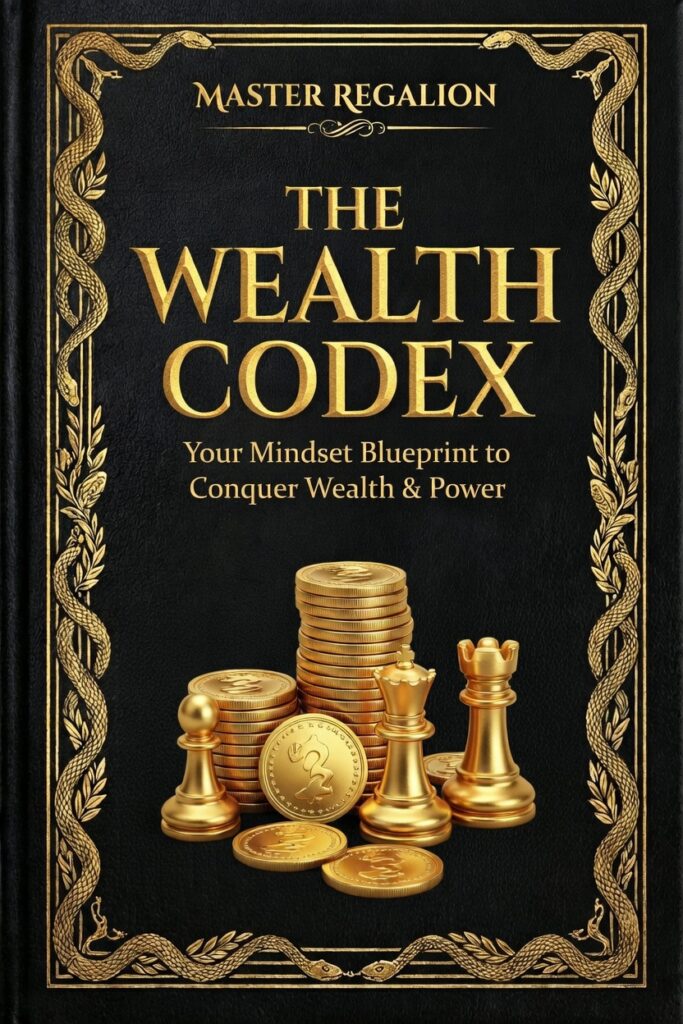
The Wealth Codex: Your Mindset Blueprint to Conquer Wealth & Power
John D. Rockefeller said he would rather earn one percent of a hundred people’s efforts than one hundred percent of his own.
That sentence is not a business philosophy. It is a complete doctrine about the difference between two fundamentally different relationships to wealth: the person who earns and the person who builds systems that earn.
Rockefeller did not become the wealthiest man in American history by working harder than everyone else. Thousands of men worked harder than Rockefeller, in more demanding conditions, for a fraction of what they produced. He understood something they did not. The game is not about effort. It is about architecture.
The Wealth Codex is about the architecture.
The wealth advice most people receive is wrong in a specific and consequential way.
Not wrong in what it recommends. Work hard, save consistently, invest wisely, build skills: none of this is bad advice. It is wrong in what it omits. It describes the behavior of people who are participating in the wealth game without explaining the structure of the game itself. It tells you how to work within the system without explaining how the system works or how the people who built it thought about it while they were building it.
The result is that most people who follow this advice faithfully work harder and longer for results that the architects of significant wealth would recognize as the inevitable outcome of a strategy that was never going to produce what they were trying to produce. Not because the effort was insufficient. Because the orientation was wrong.
The Wealth Codex corrects the orientation.
Ten Chapters. Each One Grounded in the Historical Record.
Not by interviewing modern entrepreneurs. Not by abstracting principles from business school case studies. By examining the careers of the people who built the most significant wealth in recorded commercial history with enough analytical depth to identify what they actually did and why it worked.
The Medici banking empire and the architecture of obligation that expanded it across five European capitals within two generations. The Rothschild family’s informational edge and how a courier network became the foundation of a dynasty that financed the Napoleonic Wars from both sides. Rockefeller’s identification of the refining chokepoint in the American petroleum industry. Carnegie’s understanding of technology inflection points and how arriving at the steel production revolution with no legacy investment gave him a cost position his competitors could not match.
These are not inspiring stories. They are case studies in applied understanding.
Chapter 1: The Power Mindset for Wealth
The three mental shifts that distinguish the person building wealth architecturally from the person building it through effort alone. The long game, the Medici way. The primacy of perception, the De Beers way. Emotional detachment from market conditions, the Rothschild way.
Chapter 2: Psychological Leverage in the Marketplace
Four mechanisms that have operated in human commercial psychology across every era of recorded history: Scarcity, Authority, Reciprocity, and Social Proof. Each examined through a historical case study. De Beers, J.P. Morgan, the Medici, the South Sea Bubble.
Chapter 3: The Wealth Triangle
The three-part architecture that every significant fortune in the historical record was built from: Power Capital, Strategic Capital, and Financial Capital. Why most people focus exclusively on the third and why this limits them. How Rockefeller’s career demonstrates the correct sequence.
Chapter 4: Manipulation for Advantage
Four mechanisms that operate in every significant commercial transaction: Frame Control, Anchoring, Status Manipulation, and Controlled Transparency. The Rothschild bond market operation. Carnegie’s acquisition strategy. The architecture of luxury positioning across centuries.
Chapter 5: Strategic Positioning
The chokepoint principle. How to identify where capital flows rather than where effort accumulates. The East India Company’s positioning strategy. Carnegie’s technology inflection point. The Medici partnership model for market expansion.
Chapter 6: Persuasion as a Profit Engine
Four persuasion tools grounded in documented human decision-making psychology. Storytelling through Carnegie’s constructed public narrative. The Yes Ladder through the Medici client development process. Authority signals through Morgan’s credibility architecture. Risk reversal through Richard Sears’s money-back guarantee, the innovation that created mass market retail.
Chapter 7: Building Wealth Structures That Outlast You
The Rothschild family’s multi-generational wealth architecture as the primary case study. Four structures: Asset portfolios, Automated businesses, Licensing and royalties, Equity positions. What Mayer Amschel Rothschild built that generated the family’s greatest wealth after his death.
Chapter 8: Defending Your Wealth
The psychology and strategy of protection. The Medici invisibility principle. Rockefeller’s structural complexity as legal defense. The Rothschild geographic distribution model as antifragility. Carnegie’s diversification strategy.
Chapter 9: Scaling Through Influence Expansion
Carnegie’s public authority building. The Medici patronage network as strategic alliance architecture. Rockefeller’s selective visibility: how to be highly present in the environments that matter and deliberately invisible in the ones that create risk.
Chapter 10: The Ultimate Wealth Tenets
Five operating principles distilled from the full historical record: Positioning over effort. Perception creates value faster than reality does. Leverage beats labor. Influence is the highest form of currency. Control the frame and you control the outcome.
Why the Historical Grounding Matters
Most wealth and business books present principles that sound reasonable without demonstrating them through situations where they were actually tested, where the stakes were real, and where the consequences of getting them wrong were permanent.
The historical figures in this book operated in conditions where failure was not a setback to be learned from in the next quarter. Rockefeller’s competitors who did not understand what was being built around them did not recover and pivot. They were acquired or destroyed. When a principle survives those conditions, it is not a reasonable idea. It is a demonstrated truth.
The Wealth Codex is built from demonstrated truths.
Who This Is For
This book is for the person who has understood for some time that the standard advice about wealth is incomplete but has not yet found a framework that explains what the complete picture looks like.
It is for the entrepreneur who has been building hard and generating results that do not seem proportional to the effort, and who suspects the problem is structural rather than motivational.
It is for the person who wants to understand the game rather than simply play it, because understanding the game is what makes the play sustainable.
It is the shortest book in the Tenets of Power library. It is not padded. Every page earns its place.
Objections Addressed
“There are a lot of wealth mindset books. What makes this one different?”
Most wealth mindset books are built from interviews with modern successful people and the abstraction of principles that may or may not be the actual reason for the outcomes attributed to them. The Wealth Codex is built from the historical record of the most significant wealth creation in the commercial history of the Western world, examined analytically rather than admiringly.
“Is this practical or theoretical?”
Every chapter moves from principle to historical demonstration to practical application. The theoretical framework is always in service of a specific, deployable insight. This is not a philosophy text. It is a doctrine for changing how you operate in commercial situations.
“The price seems high for a short book.”
The Wealth Codex is concentrated by design. The choice was between a longer book that said everything twice and a shorter book that said everything once at sufficient depth to actually land. The second choice was made. The price reflects the quality of the content, not its weight. If one positioning insight from Chapter 5 changes a single business decision meaningfully, the book has paid for itself many times over.
The architects of significant wealth were not better people than the people around them.
They were not working harder or getting luckier. They understood the game. They understood how value is actually assigned in markets and negotiations. They understood how to position themselves where capital flows rather than where effort accumulates.
The Wealth Codex gives you that understanding. Derived from the actual historical record of how they built it.
10 chapters. Historically grounded. The concentrated doctrine of wealth built with architectural intelligence.
From Men Who Read This.
No reviews yet. Be the first to write one.

Leave a Review
You must be logged in to post a comment.