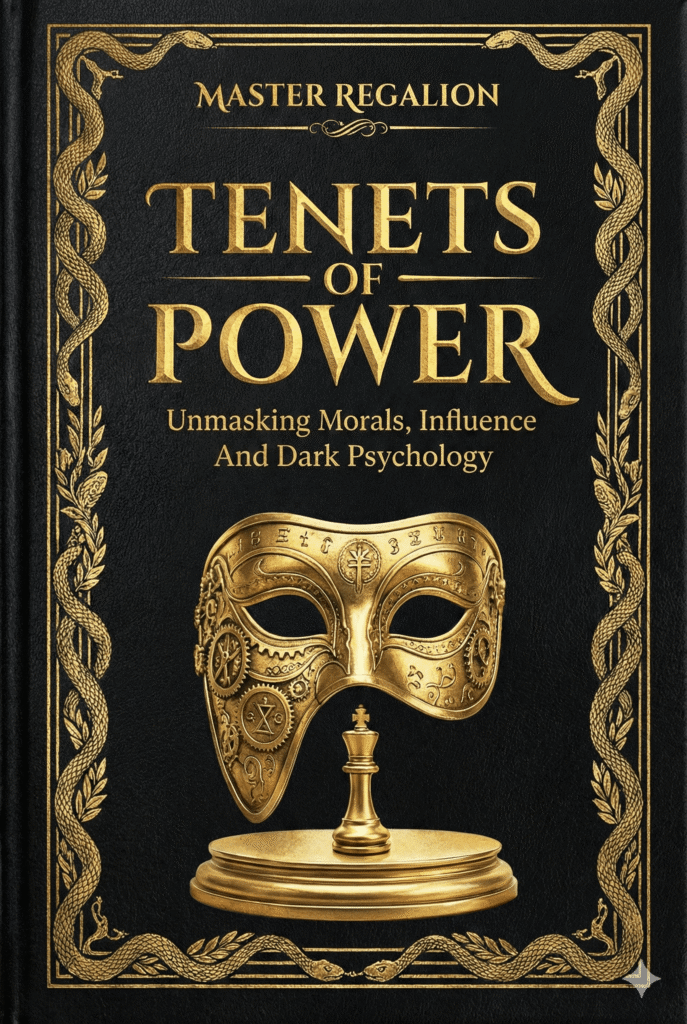
Tenets of Power: Unmasking Morals, Influence, and Dark Psychology
There is a difference between knowing tactics and understanding power.
Tactics tell you what to do in specific situations. Understanding tells you why those situations arise, what forces are actually operating inside them, and how to navigate them regardless of the specific form they take.
Most books give you tactics. This one gives you the understanding that makes every tactic available.
The Tenets of Power is the foundational doctrine of the Tenets of Power library. Not the entry point. The foundation. If The Apex Gambit is the field manual, this is the philosophy that the field manual was built from. If The Wealth Codex is the financial architecture, this is the psychological architecture that makes it buildable.
You can read this book without reading the others. But if you read this one first, everything that follows will land differently. That is what a foundational doctrine does.
Most people who study power study its surface.
They learn tactics without understanding the psychology beneath them. They recognize manipulation when it is obvious without recognizing the subtler versions that operate below the threshold of conscious awareness. They pursue influence without understanding the difference between influence that is durable and influence that collapses at the first serious test.
They know what power looks like. They do not understand what it is.
The Tenets of Power is built on a single premise: that power is a learnable discipline with a coherent underlying structure, and that understanding that structure at depth is worth more than any collection of surface-level tactics. Because when you understand the structure, the tactics become obvious derivations rather than disconnected techniques. The strategy that defeated Carthage and the negotiation tactic that closes a deal are expressions of the same underlying principle. This book is about the underlying principle.
The Five Parts
Part I: The Nature of Power
Three chapters that establish the philosophical foundation without which everything else in the book floats unanchored.
What power actually is: not a reward for virtue or an instrument of the corrupt, but a force as amoral and as indifferent as gravity, operating whether or not the people in its field understand its laws. How morality functions as architecture rather than as truth: who built the moral framework you inherited, whose interests it serves, and why examining it is not cynicism but intellectual honesty. And the inner struggle that every person serious about power must eventually engage: the confrontation between inherited values and chosen ones that precedes genuine self-mastery.
The anchors here are Nietzsche’s will to power, Machiavelli’s forensic examination of political reality, Marcus Aurelius’s lifetime of private written struggle to align action with examined values, and Augustus Caesar’s 41-year demonstration of influence so complete that control was never necessary.
Part II: The Dark Triad Unveiled
Four chapters examining the three psychological configurations that every serious student of power must understand.
Machiavellianism: the strategic mind that prioritizes outcomes over methods, manages perception as a primary operational discipline, and treats relationships as dynamic instruments rather than fixed categories. Bismarck demonstrated it across 28 years of European statecraft. Talleyrand demonstrated its durability across five different French regimes.
Narcissism: the conviction architecture that makes bold action possible, projects certainty that generates genuine followership, and carries the specific failure modes that strategic self-awareness must compensate for. Alexander the Great demonstrated both its extraordinary capability and its catastrophic failure mode in a single career. Napoleon demonstrated the same pattern a millennium later.
Psychopathy: the emotional detachment that allows difficult decisions to be made without paralysis, that operates under extreme pressure with a quality of clarity that most people cannot access under those conditions, and that carries the risks that the absence of emotional constraint always produces. Churchill demonstrated the functional expression. The clinical extremes demonstrate what happens without it.
The fourth chapter examines the Dark Triad as a unified framework: how these three configurations interact, reinforce each other, and combine to produce the psychological architecture of the most consequential operators in recorded history.
Part III: Power in Practice
Three chapters that move from theory to operation.
Resilience and grit as strategic assets, not motivational concepts. The synthesis chapter: Julius Caesar and Lorenzo de Medici as the primary historical demonstrations of all three Dark Triad configurations operating simultaneously at the highest recorded level. And the complete examination of influence versus control, demonstrated through two of the 20th century’s most consequential political operators and the dramatically different outcomes their different architectures produced.
Part IV: Mastery of Self
Three chapters on the internal architecture that makes external power sustainable.
Self-mastery through Epictetus, the man born a slave who produced the philosophical framework that shaped Marcus Aurelius and continues to shape serious practitioners of power today. The construction of a personal code through Miyamoto Musashi’s Go Rin No Sho. And the legacy question, examined through Napoleon’s extraordinary gap between power achieved and architecture built for its transmission.
Part V: The Defense
Four chapters that most power literature never includes.
How to recognize Machiavellian operation being run against you. How to identify narcissistic leadership dynamics before they cost you the position you have built inside them. How to detect psychopathic configuration in the environments you operate in. And the integrated defensive posture that makes you a genuinely expensive target regardless of which specific approach is being attempted.
The historical case studies here include Kim Philby’s 25-year operation inside British intelligence, Lyndon Johnson’s Vietnam War cabinet as the documented case study of narcissistic leadership dynamics producing catastrophic outcomes, and Frederick the Great’s multi-front defensive architecture as the most complete historical example of integrated defense against all three configurations simultaneously.
The Philosophical Anchors Are Tools, Not Decorations
Nietzsche, Machiavelli, Jung, and Greene appear in the chapters where their ideas are directly applicable, not in an appendix at the end. When the chapter on morality examines how moral architecture is constructed to serve specific interests, Nietzsche’s master and slave morality framework is the analytical instrument. When the chapter on self-mastery addresses the shadow and its integration, Jung’s concept is not referenced: it is applied.
This is what it means for philosophy to be a tool rather than a credential. It produces insights rather than impressions.
Who This Is For
This is for the person who has read widely in the power and strategy space and found themselves with a collection of tactics that do not cohere into a unified understanding. Who knows what the 48 Laws say but cannot always discern which law applies to which situation. Who has studied negotiation techniques but finds themselves reverting to instinct under actual pressure because the techniques are not grounded in a deep enough understanding of what is actually happening psychologically.
This is the book that provides that grounding.
It is also for the person who has been operated on by these principles without recognizing it. Who has experienced the Machiavellian ally, the narcissistic leader, the psychopathic operator, and felt the effects without having the vocabulary or the framework to understand what was happening. Part V was written for you specifically.
Objections Addressed
“Is this too philosophical? I want practical tools, not abstract theory.”
The doctrine in this book is practical in the most specific sense: it changes the quality of real decisions in real situations. Every chapter connects its philosophical argument to historical demonstration and practical application. The theory is always in service of the practice.
“I am already familiar with Machiavelli and the 48 Laws. Will I find anything new here?”
Yes. The Dark Triad framework examined at this depth and demonstrated through this range of historical figures is not standard content in the power and strategy space. The Defense section, which examines how to recognize these configurations being operated against you, is almost entirely absent from the existing literature.
“How is this different from The Apex Gambit?”
The Apex Gambit is the field manual. Sixty-four specific tactics, each historically demonstrated, each applicable to a specific class of situation. The Tenets of Power is the doctrine that makes the field manual legible. Reading this one first makes the other significantly more powerful, because you arrive at the tactics with a complete understanding of the psychological mechanisms they are exploiting.
Power is not a mystery. It is a discipline.
It has consistent underlying laws that operate across every era and every context. The people who have built the most significant power in recorded history understood those laws, whether they could articulate them formally or not. The Tenets of Power articulates them.
This is the complete doctrine. The philosophy, the psychology, the practice, and the defense. In a single volume that will change how you see every room you walk into, every alliance you consider, and every version of yourself you have not yet decided to become.
17 chapters. 5 parts. The foundational doctrine of power, psychology, and influence.
Ali S. –
I enjoyed reading Tenets of Power. It goes into depth of the dark triad topic which I liked.
Teddy –
Excellent book on the topic of Power.. It has philosophy, dark psychology, historical examples of Powerful people and a complete section on defending yourself against dark triad. personalities. Some topics could have been expanded further but overall I enjoyed reading the book and learning about the true philisophy of power.
Rishi P. –
This is a great book on understanding the Philosophy of Power and it gets you in the right frame of mind for studying this subject. It covers the core concepts on broad topics of the origin of Morality, influence of societal conditioning on one's mental state, dark triad and its implications. The part I liked the most was the self-mastery portion in the later half of the book because it goes beyond theory and shows you how these concepts can be applied to improve in real life, gain power and most importantly how to maintain it. Some people might prefer more of a deeper philosophical angle and might not find this book very deep, but I personally liked this style with the practical applications and found it very valuable.
Jonathan –
I first found master regalion via his instagram and because I love his historic carousals, I decide to check out his books. I went in expecting tenets of Power to be like the 48 laws of power, but it is quite different from robert greene's version of Power. The chapters on dark triad are truly unfiltered and teach you things that any other book on Power will not. My only critique of this book is that it could have covered more on the practical implications of the pursuit of power in the modern world with technology and AI advancement because I think that's a really important topic. Overall, if you are a person interested in Philosophy of Power, this is a very good book and I highly recommend.